
Master of Public Health
South University’s Master of Public Health Program is designed to educate students about areas of critical importance to local, national, and international public health challenges. This Master’s degree in Public Health program is organized around a curriculum which consists of core competencies, specialization courses, electives, and a practicum experience or applied research proposal. By completing the Public Health Master's degree program, students can develop their knowledge, skills, and abilities necessary for leading public health professionals*.

Master of Public Health (MPH) at South University is an applicant for accreditation by the Council on Education for Public Health. The accreditation review will only address the MPH degree at South University. Other degrees and areas of study offered by South University will not be included in the unit of accreditation review. For additional information concerning the application and accreditation process, please visit CEPH’s website, ceph.org.
*South University does not promise or guarantee licensure, employment, or salary amounts.
Course Requirements
Admissions Requirements
Procedure for Admission to the Master of Public Health
The criteria used in determining admissions to the Master of Public Health degree program include:
- Completion of a bachelor's degree from an accredited institution, with a cumulative grade point average (CGPA) of at least 2.5 (on a scale of 4.0) OR
- An earned graduate degree from an accredited institution with a CGPA of 3.0 or higher.
- Applicants must complete an undergraduate statistics course or equivalent (as approved by the Public Health Department Chair/Program Director) with a grade of "C" or better prior to admission to the Master of Public Health program.
- Submission of official transcripts from all postsecondary institutions attended within 5 weeks of the class start date (refer to Conditional Acceptance).
For additional admissions information please see the admissions section here.
For information regarding Conditional Acceptance, click here.
Outcomes
Upon completion of the program, students will be able to:
Explain the history, philosophy, and core functions of Public Health.
Apply evidence-based approaches that utilize quantitative and qualitative methods to inform program planning, implementation, and evaluation.
Evaluate the organization, structure, and function of Public Health and healthcare systems both nationally and globally.
Design culturally sensitive community-based health programs that address racism, structural bias, and social determinants of health to achieve health equity.
Develop written and oral public health content that is culturally competent and audience-appropriate.
Apply leadership skills to build partnerships or coalitions that advocate for policies and programs to address community health challenges.
Career Outlook
These are some of the career options* you can explore when you have earned your degree:
- Medical and Health Services Supervisors/Managers
- Community Health Workers
- Medical Administrative or Office Staff
Individuals in these roles are typically found within various sectors, including but not limited to, government services, state and municipal offices, private health agencies, and consulting firms. They work to oversee public health and provide services as-needed to ensure the welfare of a community or region.
New Student Orientation
The New Student Orientation helps students develop skills and behaviors of a successful college student:
• Learn about South University and the resources available to support their success.• Practice using the same tools they will encounter in their courses, including Discussions, Microsoft Word/PDF document uploads, and Quizzes.
• Build confidence navigating University systems through an interactive Virtual Scavenger Hunt Quiz.
• Actively engage with course content rather than simply acknowledging completion.
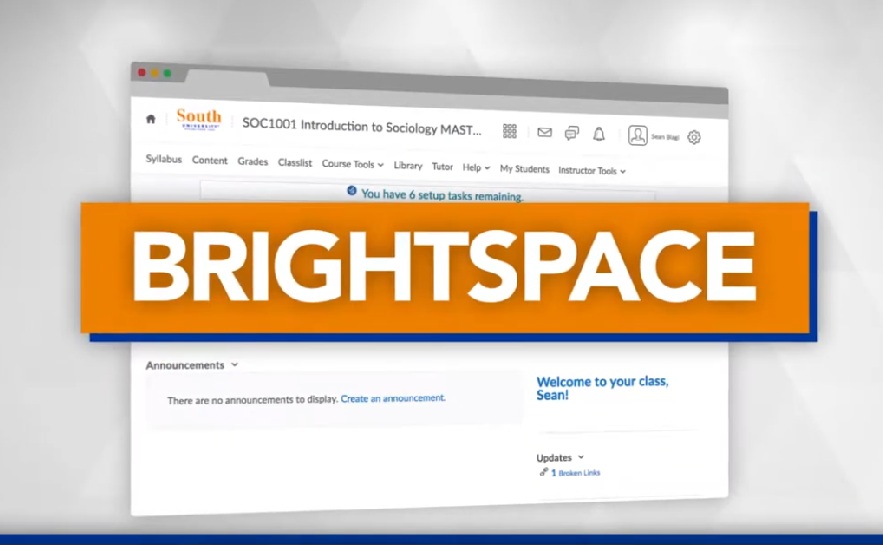
BrightSpace
BrightSpace is an online learning management platform that keeps students connected to classwork and instructors.