
Bachelor of Science in Public Health
South University’s Bachelor of Science in Public Health degree program is designed to help you develop the skills you need to assess, plan, and support the delivery of essential public health services in government, community-based, and private sector health agencies*. In the Public Health Bachelor degree program, our knowledgeable instructors provide personalized support and mentorship, drawing on their own past work experiences** to prepare you for diverse public health scenarios, settings, and dilemmas in populations of all sizes.
*South University does not promise or guarantee licensure, employment, or salary amounts.
**Credentials and experience may vary by instructor.
Course Requirements
Choose one additional course from the list below:
(must be taken concurrently)
(must be taken concurrently)
Choose four courses from the suggested electives:
Admissions Requirements
General Undergraduate Admission Requirements
Note: Not all Online Program offerings are available to residents of all U.S. states. Please contact an admissions representative for further information.
To be admitted to any of the undergraduate programs at South University, the prospective student must provide proof of high school graduation as recognized by the state of residence on the date the degree was earned, or the equivalent in which a diploma was earned, with a minimum CGPA of 1.5 on a 4.0 scale within 14 calendar days of the start date (refer to Conditional Acceptance). Students providing a GED must meet the minimum required test score deemed as passing in each section as required at the time of testing.
South University accepts the International Baccalaureate Program diploma as meeting the requirement for high school graduation. Credentials earned outside the United States must be evaluated by a NACES or AICE-member credential evaluation service. Please speak with an admissions representative for more information.
Students with less than the minimum CGPA of 1.49 on a 4.0 scale may meet admissions requirements by submitting a minimum combined SAT (Evidence-Based Reading and Writing, and Math) score of 700 or 900 on the SAT requiring an essay portion, a combined ACT score of 18, or meet the criteria established for acceptance as a transfer student.
Students with a CGPA between 1.49 to 1.0 on a 4.0 scale may be admitted provisionally for two quarters. Failure to achieve a 1.5 CGPA in the first two quarters of attendance will result in dismissal. Students may appeal the dismissal by following the Procedures for Appealing Academic/Financial Aid Dismissal Policy.
Students with less than a 1.0 on a 4.0 scale do not meet the admissions requirements for South University.
Acceptable verification of high school graduation or the equivalent would include a high school transcript (official), or GED scores and state-authorized examination scores (ex. HiSET, TASC). In states that maintain a database that serves as an official registry of high school and GED graduates, an excerpt from the official database documenting the student's graduation or GED completion may be used.
Campuses in South Carolina must be provided with official high school transcripts or GED scores.
Please see the policy on GPA Calculation for Admission for additional information
Admission of Transfer Students
Note: Not all Online Program offerings are available to residents of all U.S. states. Please contact an admissions representative for further information.
To be eligible for admission, transfer students must complete the application procedures and satisfy the following criteria:
- Submit a completed application for admission.
- Have earned 24 or more credit hours, or the equivalent (e.g. 16 semester hours), with a cumulative GPA of 1.5 from an acceptable accredited collegiate institution.
- Submit official transcripts (including verifiable faxed transcripts) from all colleges and universities attended.
- Submit self-certification of high school graduation or GED completion.
For transfer of credit practices refer to the applicable section under the Academic Affairs section of this catalog.
To be admitted as a Transfer student into South University the prospective student must have earned 24 or more quarter credit hours or the equivalent (e.g. 16 semester hours), with a cumulative GPA of 1.5 from an acceptable accredited collegiate institution. Official transcripts from the collegiate institution(s) and must be received within 14 calendar days for Undergraduate programs of the start date (refer to Conditional Acceptance). The student will be exempted from taking the UVC1000 Strategies for Success course. Students will select another 4-quarter credit course in consultation with their Academic Advisor or Academic Counselor to fulfill the degree requirements.
Students with 24 or more quarter credits with a CGPA of between 1.49 to 1.0 may be admitted provisionally for two quarters. Failure to achieve a 1.5 GPA in the first two quarters of attendance will result in dismissal. Students may appeal the dismissal by following the Procedures for Appealing Academic/Financial Aid Dismissal Policy.
Students who are citizens of countries other than the United States should refer to the section entitled International Student Admissions Policy.
Students who are transferring from or to a school within the University of North Carolina or the North Carolina Community College System should be aware of the Comprehensive Articulation Agreement approved by both governing Boards on March 1, 1996 and revised in September of 2008. This agreement may be found in its entirety at the following website.
For additional admissions information please see the admissions section here.
For information regarding Conditional Acceptance, click here.
Outcomes
Upon completion of the program, students will be able to:
- Compare governmental and non-governmental healthcare systems and public health initiatives in the United States and globally.
- Explain the philosophy and essential services of public health at the local, state, national and global level.
- Demonstrate an understanding of health disparities and determinants of health in both healthcare settings and the community.
- Demonstrate the ability to apply, evaluate and synthesize public health information including evidence-based practice and approaches.
- Formulate approaches to planning, assessing, implementing, and evaluating public health programs
Career Outlook
These are some of the career options* you can explore when you have earned your degree:
- Medical and Health Services Supervisors/Managers
- Community Health Workers
- Medical Administrative or Office Staff
Individuals in these roles are typically found within various sectors, including but not limited to, government services, community-based health agencies, and private health agencies. They work to provide essential public health services to individuals and communities. Some also continue their studies in graduate or professional schools.
New Student Orientation
The New Student Orientation helps students develop skills and behaviors of a successful college student:
• Learn about South University and the resources available to support their success.• Practice using the same tools they will encounter in their courses, including Discussions, Microsoft Word/PDF document uploads, and Quizzes.
• Build confidence navigating University systems through an interactive Virtual Scavenger Hunt Quiz.
• Actively engage with course content rather than simply acknowledging completion.
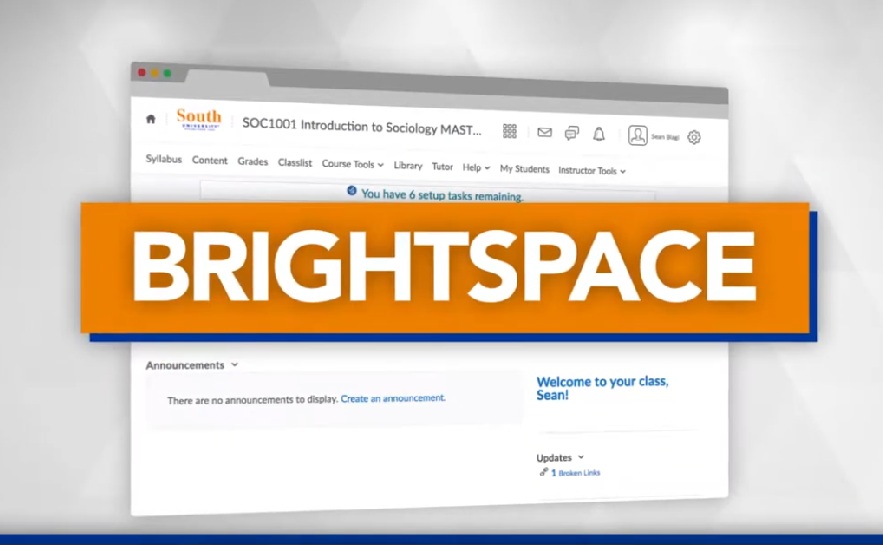
BrightSpace
BrightSpace is an online learning management platform that keeps students connected to classwork and instructors.