
RN to Master of Science in Nursing w/ a specialization in Nursing Informatics
The RN to MSN degree online* program with a specialization in Nursing Informatics is designed to help you pursue a leadership role in nursing informatics. Help your organization care for patients with a better understanding of technology and patient information, as well as have the opportunity to learn how to report and track patient outcomes to support evidence-based practice as part of this MSN online program.

 The Bachelor of Science in Nursing, the Master of Science in Nursing, and Doctor of Nursing Practice Programs at South University are accredited by the Commission on Collegiate Nursing Education (http://www.ccneaccreditation.org).
*Programs, including all Clinical/Medical programs, have a required in-person clinical, practicum, or externship. We cannot guarantee flexibility in these components of the program.
**South University does not promise or guarantee licensure, employment, or salary amounts.
Course Requirements
A block transfer of 78 quarter credits applies per the General Education Course Transfer Credit RN to Bachelor of Science in Nursing (BSN and RN to Master of Science in Nursing (MSN) policy.
78 quarter credits included in Transfer of Credit for Associate of Nursing Degree or Bachelor’s Degree.
Offered at Online Programs.
Note: Not all Online Program offerings are available to residents of all U.S. states. Please contact an admissions representative for further information.
Specialization Program Student Learning Outcomes
Upon completion of the program, students will:
- Formulate and document for various differential and presumptive diagnoses in the adult or gerontological patient with meticulous detail, so coders and billers can apply the correct codes for appropriate reimbursement.
- Develop plans of care based on theories of ageing, assessment findings, and best-practices to provide holistic, patient-centered care for the adult gerontological populations.
- Collaborate with interprofessional associates to provide culturally competent, and sensitive patient-centered care for the adult gerontological client.
*If the student receives a failing grade in NSG6021, the student must enroll in and pass the following four (4)-credit hour course: NSG6023 Nurse Practitioner Enhancement.
*If the student is unsuccessful in NSG6998_A please refer to Program Progression Policy for Family Nurse Practitioner and Adult Gerontology Nurse Practitioner Students
Offered at Online Programs.
Note: Not all Online Program offerings are available to residents of all U.S. states. Please contact an admissions representative for further information.
Specialization Program Student Learning Outcomes
Upon completion of the program, students will:
- Formulate and document for various differential and presumptive diagnoses in patients across the lifespan with meticulous detail, so coders and billers can apply the correct codes for appropriate reimbursement.
- Develop plans of care based on theories of development, assessment findings, and best-practices to provide holistic, patient-centered care across the lifespan.
- Collaborate with interprofessional associates to provide culturally competent, and sensitive patient-centered care for individuals and families across the lifespan.
*If the student receives a failing grade in NSG6021, the student must enroll in and successfully pass the following four (4)-credit course NSG6023 Nurse Practitioner Enhancement
*If the student is unsuccessful in NSG6998_F please refer to Program Progression Policy for Family Nurse Practitioner and Adult Gerontology Nurse Practitioner Students
Offered at Online Programs.
Note: Not all Online Program offerings are available to residents of all U.S. states. Please contact an admissions representative for further information.
Specialization Program Student Learning Outcomes
Upon completion of the program, students will:
- Develop strategic plans and systems which guides practices that support patient centered care for culturally diverse populations.
- Organize inclusive interprofessional relationships which assist in the development of innovative and effective care for diverse communities and settings.
- Construct quality improvement plans which integrate concepts of economics and fiscal stewardship in the leadership and management of a variety of healthcare settings.
Offered at Online Programs.
Note: Not all Online Program offerings are available to residents of all U.S. states. Please contact an admissions representative for further information.
Specialization Program Student Learning Outcomes
Upon completion of the program, students will:
- Contribute too all phases of the curriculum development for a variety of educational and healthcare settings.
- Develop quality healthcare contributions through the development of evidence-based policies for creating change and advancing the profession.
- Develop educational quality improvement plans which contribute to the creation of evidence that underlies best practices in teaching and learning.
Note: Students who have successfully completed Pharmacology, Pathophysiology and Physical Assessment courses can receive credit towards NSG6104. Students must have successfully completed all three courses with a B or better to receive this credit.
Offered at Online Programs.
Note: Not all Online Program offerings are available to residents of all U.S. states. Please contact an admissions representative for further information.
Specialization Program Student Learning Outcomes
Upon completion of the program, students will:
- Formulate principles and concepts of project management for the implementation of information systems in the provision of patient-centered care for various healthcare settings.
- Extract data from clinical data sets to provide evidenced-based support for identification of potential problems and trends.
- Evaluate documentation within healthcare information systems to provide insight for quality improvement and strategic planning.
Admissions Requirements
Procedure for Admission to the RN to Master of Science in Nursing Degree Program
Note: Not all Online Program offerings are available to residents of all U.S. states. Please contact an admissions representative for further information. The criteria to determine admission to the Master of Science in Nursing degree program include:
- Completion of the application for admission.
- Satisfy one of the following:
- Earned an associate's degree in nursing from an accredited institution,
- have an equivalent accredited associate's degree in nursing from a foreign institution, or
- hold a nursing diploma AND a bachelor's degree from an accredited institution.
- A cumulative CGPA of 2.5 or better on a 4.0 scale.
- Submission of official transcripts from every college or university attended within 5 weeks of the class start date (refer to Conditional Acceptance).
- A valid and unencumbered license as a registered nurse in all US states or territory in which the student is licensed, including the state in which the student completes all assignments for the program. (Note that military, federal, and foreign educated nurses must meet this state requirement for nursing licensure).
Note: In order to progress into Graduate level nursing courses, a student must have a 3.0 cumulative GPA. Students with a cumulative GPA of less than 3.0 may transition to the RN to BSN program to complete their BSN and then apply for the MSN program.
For additional admissions information please see the admissions section here.
For information regarding Conditional Acceptance, click here.
Outcomes
Upon completion of the program, students will be able to:
Synthesize current scientific research, theories, and concepts from nursing and other disciplines in the practice of professional nursing.
Collaborates directly with other healthcare professionals using evidence-based resources and technologies in various aspects of the advanced nursing leadership role.
- Apply critical thinking skills in establishing priorities, delegating responsibility, formulating decisions, and maintaining accountability in the practice of professional nursing through the application of nursing standards.
- Demonstrate proficiency using the nursing process and systematic inquiry to deliver evidenced-based, comprehensive, and holistic nursing care which promotes health and quality of life for diverse populations.
- Demonstrate professionalism using ethical and legal standards of practice in the decision-making process to assist with the development of quality improvement in the healthcare setting(s).
Model a professional leadership role to formulate comprehensive plans of action for ongoing contributions to healthcare system improvements.
Formulate a plan for ongoing contributions to improvement of healthcare delivery and development of health policy in a cost-effective manner.
Demonstrate ethical and legal standards of practice in the decision-making process to assist with the delivery of quality care associated with a specialty area of advanced nursing practice
Career Outlook
With your degree program complete, you'll be qualified to pursue a career** as an Nursing Informatics Specialist.
Individuals in these roles are typically found within various sectors, including but not limited to, hospitals, private physician and counseling practices, nursing facilities, community clinics and agencies, and research organizations. They use data, statistics, and other scientific studies to inform decision-making in nursing care.
New Student Orientation
The New Student Orientation helps students develop skills and behaviors of a successful college student:
• Learn about South University and the resources available to support their success.• Practice using the same tools they will encounter in their courses, including Discussions, Microsoft Word/PDF document uploads, and Quizzes.
• Build confidence navigating University systems through an interactive Virtual Scavenger Hunt Quiz.
• Actively engage with course content rather than simply acknowledging completion.
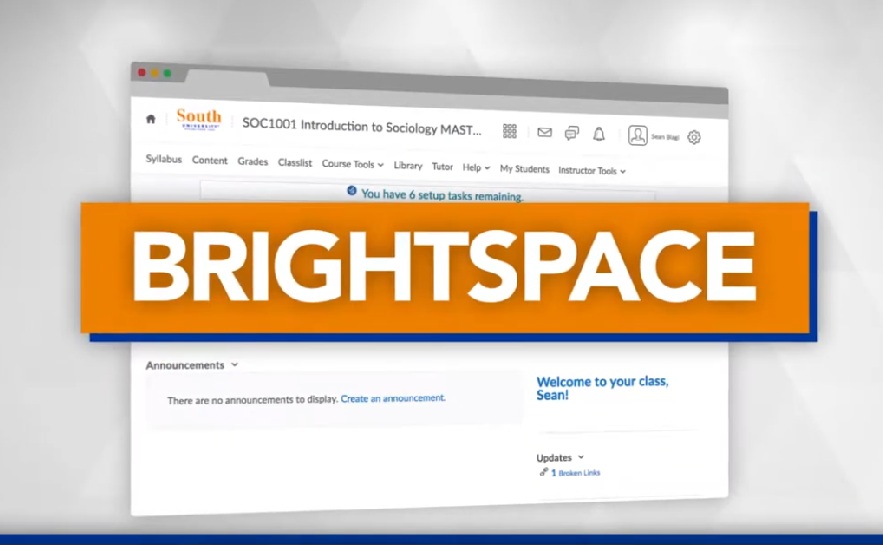
BrightSpace
BrightSpace is an online learning management platform that keeps students connected to classwork and instructors.